
This is due to the newly formed Union Territories of Jammu and Kashmir, and Ladakh, which will get funds from the Centre's share, which means devolution will be for 28 states compared to 29 earlier.
Any reduction in devolution could aggravate the strained relations between the Centre and some opposition-ruled states on a number of issues, including CAA.

The bulk of states' revenue comes from the devolution from the Centre's divisible tax pool, GST, VAT on petroleum, and excise duty on alcohol.

Processes are at an advanced stage for a number of assets of the Centre and central public sector enterprises (CPSEs) to be monetised. The assets include office space, apartments, factories, land, power transmission assets, sports stadia, gas pipelines, and telecom assets.

DDT is levied on dividends that a company pays its shareholders out of its profits. It is currently charged at the rate of 20.55 per cent, including a surcharge and education cess. Government may instead tax the shareholders receiving dividends, in a bid to help improve investor sentiment by addressing the multiplicity of taxes and bring down the effective tax rates for companies.

A robust dispute settlement system would help the government unlock tax revenues, and also aid ease of doing business.
Oil sank to the lowest level in a month after shedding all of its gains from the US-Iran clash as traders waited to see whether any further hostilities will disrupt exports from the East Asia.

The instruction is that audit of large units be completed within seven working days, of medium units in five working days and of small ones in three.

In fact, India's investment activity growth is also estimated to touch a 17-year low in FY20. With overall demand not showing signs of revival, investment activity may take longer to recover, economists said.

If the fiscal deficit for the year can be maintained at Rs 7.04 trillion, the deficit as a percentage of GDP will slip to 3.44 per cent
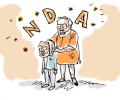
'The AMs are a different beast and reflect the political play within the government.' 'Prime Minister Modi does not need to assuage any interest group to take the final call on any decision that belongs rightfully to the Cabinet,' points out Subhomoy Bhattacharjee.

The department notified ITR 1-Sahaj and ITR 4-Sugam in January against the usual practice of notifying returns in April, with disclosure requirements related to cash deposits, spending on foreign travel, and electricity. The notification of the returns followed Budget announcements making income-tax return filing mandatory for certain persons even if their income was below the taxable limit.
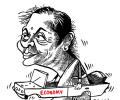
While the situation Sitharaman finds herself in may not be that good, how does it stack up against her three immediate predecessors Pranab Mukherjee, P Chidambaram and the late Arun Jaitley?
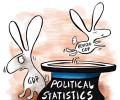
It is also likely to assume a deflator of around 4 per cent. That could take the nominal GDP outlook for FY21 to around 10 per cent. It is this nominal GDP forecast on the basis of which the finance ministry is calculating key Budget targets like the fiscal deficit as a percentage of GDP and tax revenue growth for the coming year.
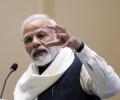
Starting today, Modi and top officials in the Prime Minister's Office will be briefed by various central ministries and departments on their plans as well as agenda for the next five years. They will also apprise the PMO of the work they have done so far in realising the agenda of government's second term in office.

Finance Minister Nirmala Sitharaman will present her second Budget a little more than a month from now. Like any other FM, Sitharaman will depend on her team of bureaucrats and advisors to frame and present the Budget.

In 2009, the UPA government, had announced a slew of measures to boost liquidity in NBFCs. These included a scheme for providing liquidity support to NBFCs having assets size of over Rs 100 crore through a SPV.
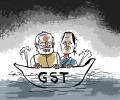
Bihar Deputy Chief Minister Sushil Kumar Modi said, a hike in GST rates would have hampered consumption amid the economic slowdown. The revenue augmentation panel in the Council meeting recently recommended revisiting and restructuring the GST rate slabs, besides correcting the inverted duty structure. The panel listed 24 items, including mobile phones, footwear, fabrics, LED light, medical equipment, utensils, agri machinery, pharma, and renewable components, which have an inverted duty structure, resulting in refunds of close to Rs 20,000 crore annually.
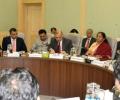
At a pre-Budget meeting, the FM was asked to ensure that NBFCs come out of the liquidity crisis they are facing with the help of RBI. They also spoke about the futility of trying to achieve a 3 per cent fiscal deficit target over the medium term.

The new restriction will be challenging for businesses, as they will have to do regular follow-ups with their suppliers.
 © 2025 Rediff.com - Investor Information - Advertise with us - Disclaimer - Privacy Policy - Sitemap - Feedback - About us - Terms of use - Grievances